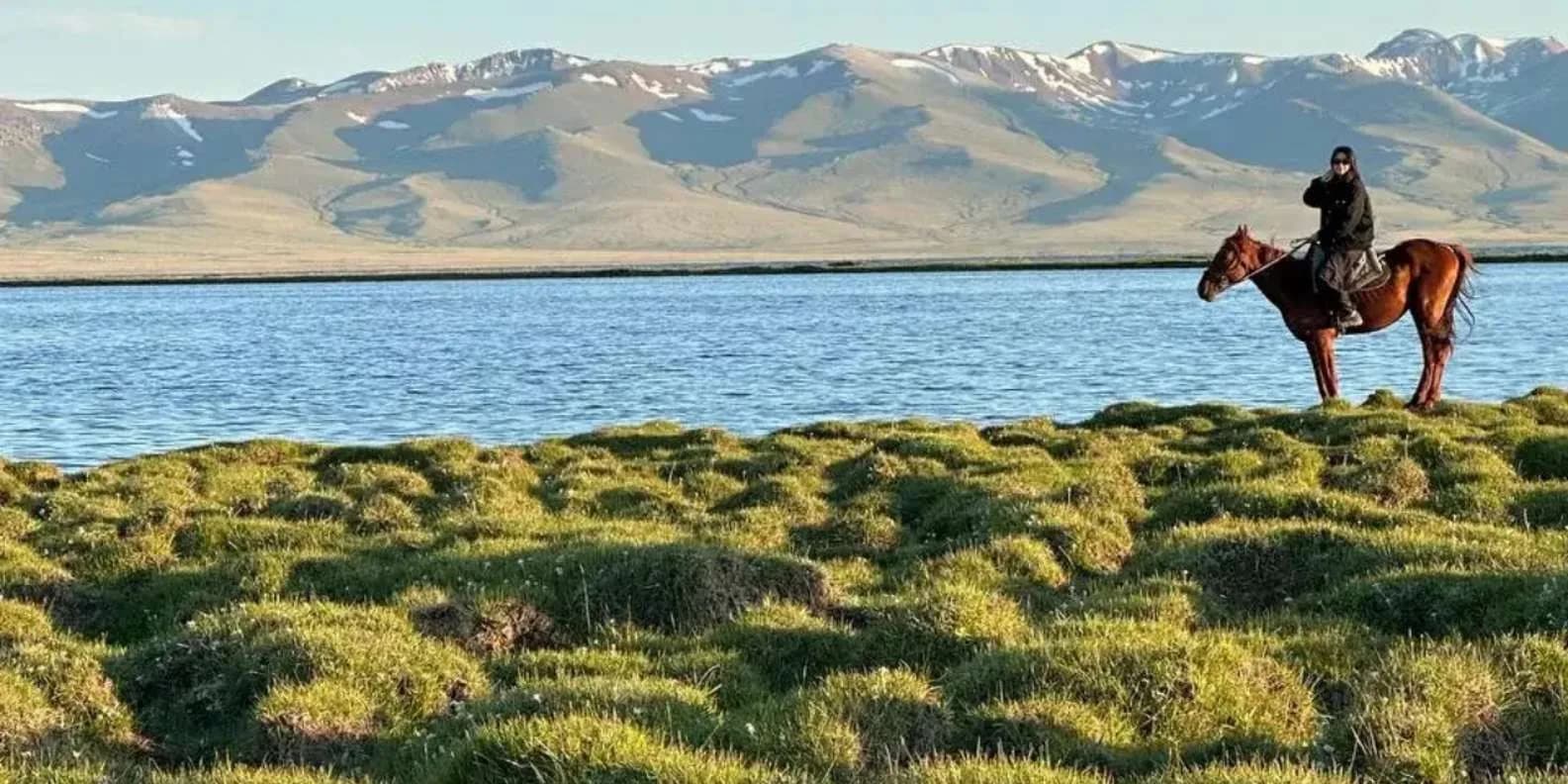
 Image via GetYourGuide
Silk Road in Kyrgyzstan: Sites & Route (2026)
Kyrgyzstan's Silk Road is a mountain corridor, not oasis cities. The history, the sites to visit — Burana, Tash Rabat, Osh, Uzgen — and a route to trace it.
Book it on This is Kyrgyzstan
Turn this guide into a trip
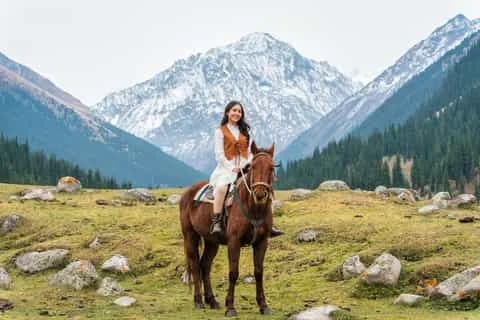
Kyrgyzstan's stretch of the Silk Road is a mountain corridor, not a string of grand cities. Where Uzbekistan gives you Samarkand and Bukhara, Kyrgyzstan gives you the high passes those caravans had to climb, the last stone shelter before the crossing into China, and a bazaar town at the point where a mountain track becomes a valley road. The trade came through the Tian Shan, over passes above 3,000 m, carried as much by nomads and their pack animals as by settled merchants. You can still trace it: the Burana minaret in the Chuy valley, the Tash Rabat caravanserai below the Torugart Pass, and Osh with its sacred mountain and ancient market at the head of the Fergana Valley.
Kyrgyzstan's place on the Silk Road
Think of the country as the roof the road had to cross. The main branches ran through three lowland threads — the Chuy valley in the north, the Issyk-Köl basin, and the Fergana rim in the south — linked by brutal high crossings over the Tian Shan into the Tarim Basin and Kashgar. This was the northern Silk Road, the alternative to the desert route through the Taklamakan, and its defining feature is altitude. Caravans gained and lost thousands of metres, waited out weather, and depended on shelter and pasture that only worked in summer.
That geography shaped who ran the trade. This was nomad country. Kyrgyz and earlier Turkic and Saka peoples grazed the high pastures and knew the passes, and much of the through-traffic moved as pack strings rather than in the great walled entrepôts you find further west. The settled side existed too — the Karakhanids, the first major Turkic dynasty of the region to adopt Islam, founded Balasagun in the Chuy valley at the end of the 9th century, and cities like Suyab and Nevaket grew along the northern branch. But the country never produced a Samarkand. Its Silk Road heritage is passes, caravanserais, petroglyph fields, ruined towns and a sacred mountain, rather than monumental madrasas.
UNESCO recognises the northern thread formally. Three Kyrgyz sites — the cities of Balasagun (the Burana site), Suyab (Ak-Beshim) and Nevaket (Krasnaya Rechka), all in the Chuy valley within day-trip range of Bishkek — are inscribed as part of the transnational Silk Roads: Routes Network of Chang'an-Tianshan Corridor (2014), shared with China and Kazakhstan. In the south, Sulaiman-Too at Osh is a World Heritage site in its own right (2009), described by UNESCO as a landmark and beacon that guided caravans down into the Fergana Valley. There is even a theory, worth reporting as a theory rather than a fact, that Ptolemy's fabled "Stone Tower" — the traditional midpoint of the road between Europe and Asia — stood at Sulaiman-Too. Other candidates sit in Tajikistan.
The Silk Road sites you can actually visit
Five places do most of the work if you want to trace the road on the ground. Here is what each one is and where it sits.
| Site | What it is | Where | Silk Road role |
|---|---|---|---|
| Burana Tower / Balasagun | 11th-c. Karakhanid minaret, plus balbal stones, mausoleums and petroglyphs | ~80 km E of Bishkek, near Tokmok, Chuy valley | Minaret of a lost Karakhanid capital; UNESCO Silk Roads component |
| Tash Rabat | Intact stone caravanserai, 31 domed rooms | At-Bashy district, Naryn region, ~3,200 m | Last shelter before the Torugart Pass to Kashgar |
| Sulaiman-Too | Sacred five-peaked mountain, cave museum, shrines | Rising out of Osh city | UNESCO landmark and beacon for caravans entering Fergana |
| Osh bazaar | Historic market town at the valley head | Osh, southern Kyrgyzstan | Where the mountain route becomes the Fergana valley route |
| Uzgen | Karakhanid minaret and three mausoleums | ~55 km NE of Osh, Fergana rim | Karakhanid centre on the eastern Fergana Silk Road |
Burana Tower and ancient Balasagun
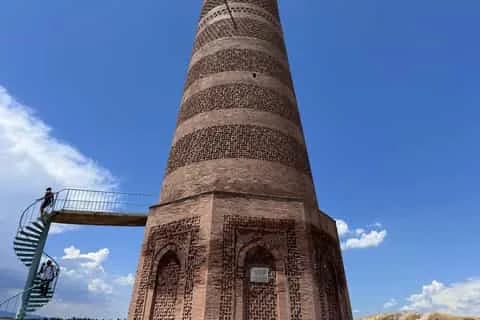
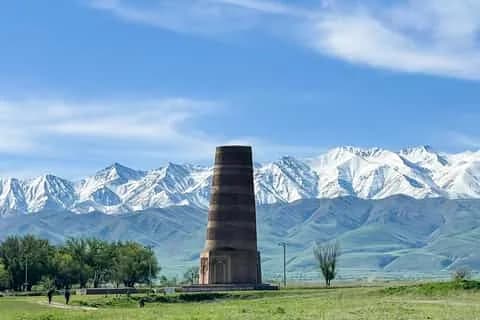
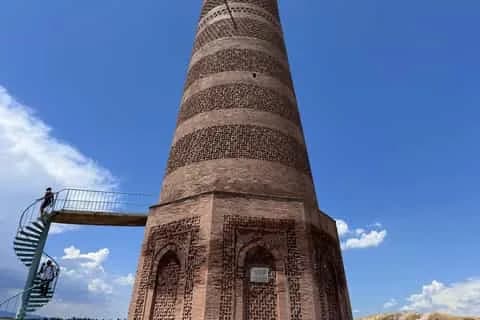
Burana is the surviving minaret of Balasagun, the Karakhanid capital in the Chuy valley. Built in the 11th century, it stood around 45 m tall until a series of earthquakes — the worst in the 15th century — cut it down to its present ~25 m; a 1970s restoration stabilised the base. Around it lie the traces of the vanished town: grave markers, castle remnants, three mausoleums, petroglyphs and a scattered field of balbals, the carved Turkic stone figures used as grave markers. A steep internal spiral takes you to the top for a view over the Chuy plain. Balasagun was home to Yusuf Balasaguni, who wrote the 11th-century Turkic mirror-for-princes Kutadgu Bilig. It is an easy half-day from the capital; the Burana Tower guide has the practical detail.
Tash Rabat, below the Torugart Pass
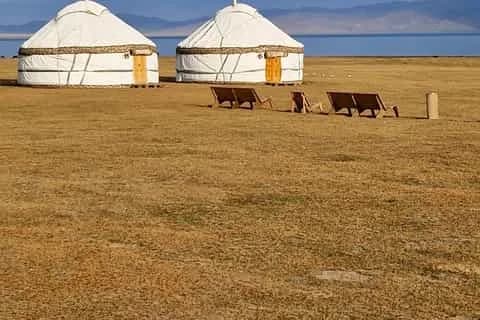
Tash Rabat is the single most atmospheric Silk Road ruin in the country, and unusually it is not a ruin — the thick-walled stone building, 31 domed rooms around a central hall, stands substantially intact at around 3,200 m in a grassy side-valley of the At-Bashy range. It sits exactly where a caravan stop belongs: a day below the Torugart Pass, in the last sheltered valley before the crossing into the Tarim Basin. The dating is genuinely unresolved — most sources say 15th century, some argue for a 10th-century origin, and there are competing theories that it began as a Nestorian Christian or a Buddhist monastery rather than a caravanserai. Treat that as the mystery it is. Sleeping in one of the yurt camps beside it, after the day-trippers leave, is the point. Admission has been around 150 som (roughly US$1.70); confirm on the day, and note there is no mobile signal and no ATM anywhere near. See the Tash Rabat guide and the Naryn travel guide for logistics — Naryn is the town where you arrange the 4WD, cash and any permits.
Osh, its bazaar and Sulaiman-Too
Osh is where the road changes character. Coming west out of Kashgar over the Tien Shan and the Alay, the routes drop onto the Fergana Valley floor here and run on to Samarkand and Bukhara — Osh is the hinge where a mountain route becomes a valley route, which is the whole reason the city exists. Its market is claimed, in the standard local telling, to have traded on the same ground for around 2,000 years. One honest caveat: during 2025 the city relocated its major markets, including the famous riverside Jayma Bazaar, out of the centre, so check what still trades on the old ground before you build a day around it.
Above the city rise the five peaks of Sulaiman-Too, Kyrgyzstan's first World Heritage site and the only one lying wholly within its borders. UNESCO calls it the most complete example of a sacred mountain in Central Asia, worshipped across several millennia; it holds 101 petroglyph sites, active shrines, two reconstructed 16th-century mosques and a striking cave museum built into the rock. It is an active pilgrimage site, mostly for domestic visitors, so dress and behave accordingly. Full detail is in the Osh travel guide and the Sulaiman-Too guide.
Uzgen's Karakhanid minaret
An hour or so north-east of Osh, on the Fergana rim, Uzgen (Özgön) keeps a brick minaret and a row of three adjoining mausoleums from the Karakhanid period, roughly the 11th and 12th centuries — the same dynasty that built Balasagun. The carved terracotta brickwork is the draw. It is an easy add-on by shared taxi from Osh, and it rounds out the southern half of the Karakhanid story that begins in the Chuy valley at Burana. Confirm current opening arrangements locally.
A Silk Road route through the country
The road divides naturally into a northern and a southern half, and the honest answer is that you don't drive both in a hurry. A practical week-plus itinerary that follows the historic grain looks like this:
- Chuy valley (1–2 days): Bishkek as a base, then Burana, with Ak-Beshim and Krasnaya Rechka nearby for the completists. All three are the UNESCO Silk Roads components.
- Over the Tian Shan (2–3 days): south via Kochkor and Naryn to Tash Rabat, sleeping in the valley below the Torugart Pass. Naryn is ~316 km / about 7 hours from Bishkek; Tash Rabat is a further ~2–2.5 hours.
- The south (2–3 days): fly Bishkek–Osh (about 40 minutes) rather than drive the ~600 km road, which is a 10–12 hour day. In and around Osh: Sulaiman-Too, the bazaar, and Uzgen's minaret.
That sequence traces the road as it was travelled — down from the Chuy oases, over the passes, and out onto the Fergana Valley — without doubling back. Time it for roughly mid-June to mid-September, when the high-mountain sites and the Tash Rabat yurt camps are open. The general Kyrgyzstan travel guide covers seasons and logistics in more depth.
How the nomad road differs from Samarkand and Bukhara
If you have seen the Registan, the contrast is the whole point. Uzbekistan's Silk Road is a chain of oasis cities — monumental, urban, built to overwhelm, with tiled madrasas and covered bazaars. Kyrgyzstan's is the high corridor between them: caravanserais, ruined towns you have to imagine back into existence, petroglyphs, passes, and jailoo pasture. The heritage here is quieter and more physical — you feel the altitude and the weather that the trade had to survive, rather than reading it off a facade. Many travellers pair the two, crossing between the Fergana Valley and Uzbekistan, precisely to get both registers of the same road. The trade-offs are laid out in the Kyrgyzstan vs Uzbekistan guide.
Crossing to China, and links to Uzbekistan
The two modern China crossings sit on the old caravan lines. Torugart (around 3,750 m, though sources differ) is the pass above Tash Rabat, on the road to Kashgar — scenically the Silk Road crossing, but logistically the hard one: restricted opening hours, closed at weekends and on Chinese holidays, no public transport, and a vehicle switch at the border line. Rules here change often, and the approach past Tash Rabat toward Chatyr-Köl runs through a restricted border zone that needs a permit arranged in Naryn, so verify the current position before you commit. Irkeshtam (around 3,000 m), reached from Osh, is the freight crossing and the usual default for independent travellers, as it doesn't demand pre-arranged Chinese transport in the same way.
Westward, Osh is only 1–2 hours from the Uzbek Fergana Valley via the Dostuk crossing near Andijan — the natural continuation of the road toward Samarkand. That proximity is why Osh feels like a Fergana bazaar town rather than a post-Soviet capital.
Practical notes
Season is the first constraint: Tash Rabat and Torugart are reliably snow-free only from late May to end September, and the yurt camps track the grass and the passes. Carry cash — there are no ATMs beyond Naryn on the southern high roads, or beyond Osh toward Irkeshtam. Budget for altitude at Tash Rabat, where you arrive at 3,200 m from Naryn's 2,000 m in a couple of hours. And treat any single figure for a fee, an opening hour or a border rule as provisional; this is fast-moving country and the honest move is to confirm on the day.
Ready to build a trip around it? Browse culture and history tours or start from the Osh destination hub for the southern half of the road.
Chat with a real person — free
Seif and the team reply on WhatsApp 24/7 — trip questions, custom plans and booking help.
Ask Seif on WhatsAppCommon questions
Was Kyrgyzstan really on the Silk Road?
Yes. The northern branches of the Silk Road ran through Kyrgyzstan, linking China with the oasis cities to the west over the Tian Shan. The Chuy valley, the Issyk-Köl basin and the Fergana rim carried the trade, and three Chuy-valley sites are inscribed as part of UNESCO's Silk Roads Chang'an-Tianshan Corridor. Sulaiman-Too at Osh is a separate World Heritage listing.
What is the best Silk Road site to visit in Kyrgyzstan?
Tash Rabat is the most evocative: an intact stone caravanserai at around 3,200 m in a remote Naryn valley, a day below the Torugart Pass to Kashgar. For accessibility, Burana Tower near Bishkek and Sulaiman-Too at Osh are easier. If you only have time for one, Tash Rabat gives you the mountain Silk Road at its most physical.
How is Kyrgyzstan's Silk Road different from Uzbekistan's?
Kyrgyzstan is the mountain corridor between the oasis cities, not the cities themselves. Where Uzbekistan has monumental Samarkand and Bukhara with tiled madrasas, Kyrgyzstan has high passes, caravanserais, ruined towns and petroglyphs. It was more nomad-and-caravan than grand urban trade. Many travellers pair the two to see both halves of the same road.
What is Tash Rabat and why does it matter?
Tash Rabat is a thick-walled stone caravanserai of 31 domed rooms in the At-Bashy range of Naryn region, at around 3,200 m. It sheltered caravans in the last valley before the Torugart Pass into China. Its date is debated — most say 15th century, some 10th — and some scholars argue it began as a Nestorian or Buddhist monastery. That unresolved history is part of the appeal.
Do I need a permit for Tash Rabat or the Torugart Pass?
Tash Rabat itself needs no permit. But the border zone beyond it toward Chatyr-Köl and the Torugart Pass is restricted and requires a permit arranged in Naryn, typically a few days ahead. Border rules at Torugart change often, so confirm the current position before travelling. Irkeshtam, reached from Osh, is generally simpler for independent travellers.
Can I cross from Kyrgyzstan to China on the Silk Road route?
Yes, at two crossings. Torugart, above Tash Rabat, is the scenic Silk Road pass but logistically hard — limited hours, weekend and holiday closures, and a required vehicle switch at the border. Irkeshtam, from Osh, is the freight crossing and usually easier for independent travellers. Both need current rules checked, as they change frequently.
What can I see of the Silk Road in Osh?
Osh sits where the mountain route drops onto the Fergana Valley. Climb Sulaiman-Too, a UNESCO sacred mountain UNESCO calls a beacon for caravans, with petroglyphs, shrines and a cave museum. The historic bazaar traded here for centuries, though note the main markets were relocated out of the centre in 2025. Uzgen's Karakhanid minaret is an easy add-on nearby.
How long do I need to trace the Silk Road in Kyrgyzstan?
Allow at least a week to a week and a half. Give one to two days to the Chuy valley sites near Bishkek, two to three to cross the Tian Shan to Tash Rabat and Naryn, and two to three in the south around Osh and Uzgen. Fly Bishkek–Osh rather than drive the 10–12 hour road to save a full day each way.
When is the best time for a Silk Road trip in Kyrgyzstan?
Roughly mid-June to mid-September. The high-mountain sites — Tash Rabat, the Torugart approach and the yurt camps — are reliably open only in that window, and the Torugart Pass is usually snow-free from late May to end September. The lower sites like Burana and Osh work in the shoulder months, but the mountain crossings do not.
Book it on This is Kyrgyzstan
Turn this guide into a trip



Kyrgyzstan's bestsellers
The experiences travelers book most, across the country
Keep reading
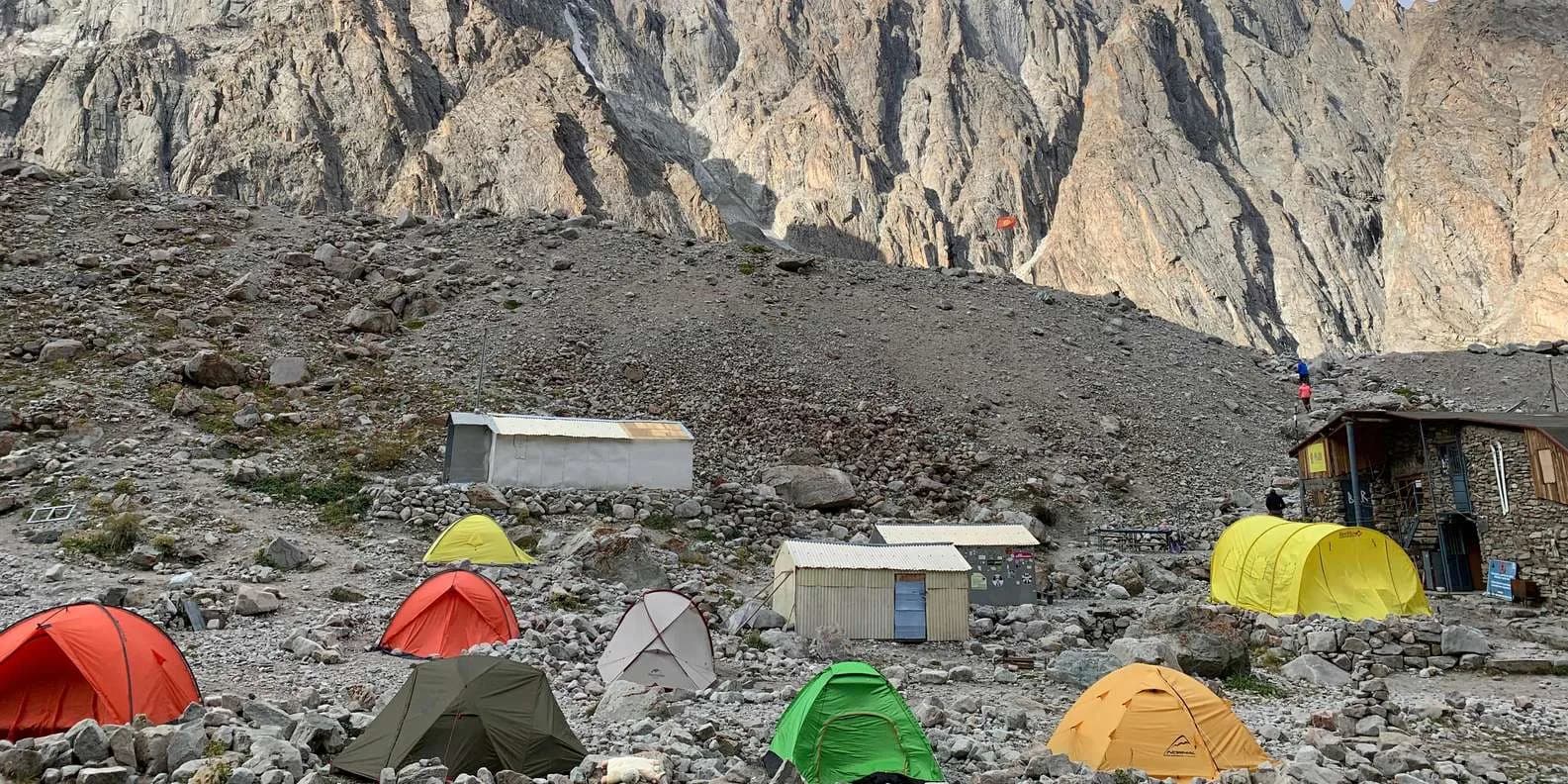
Uchitel Peak: Your First 4,000m Climb (2026)
Pik Uchitel (~4,400-4,600 m) in Ala-Archa is the classic first summit for fit hikers new to mountaineering: route, gear, season and acclimatisation.
By TiK Editors8 min read
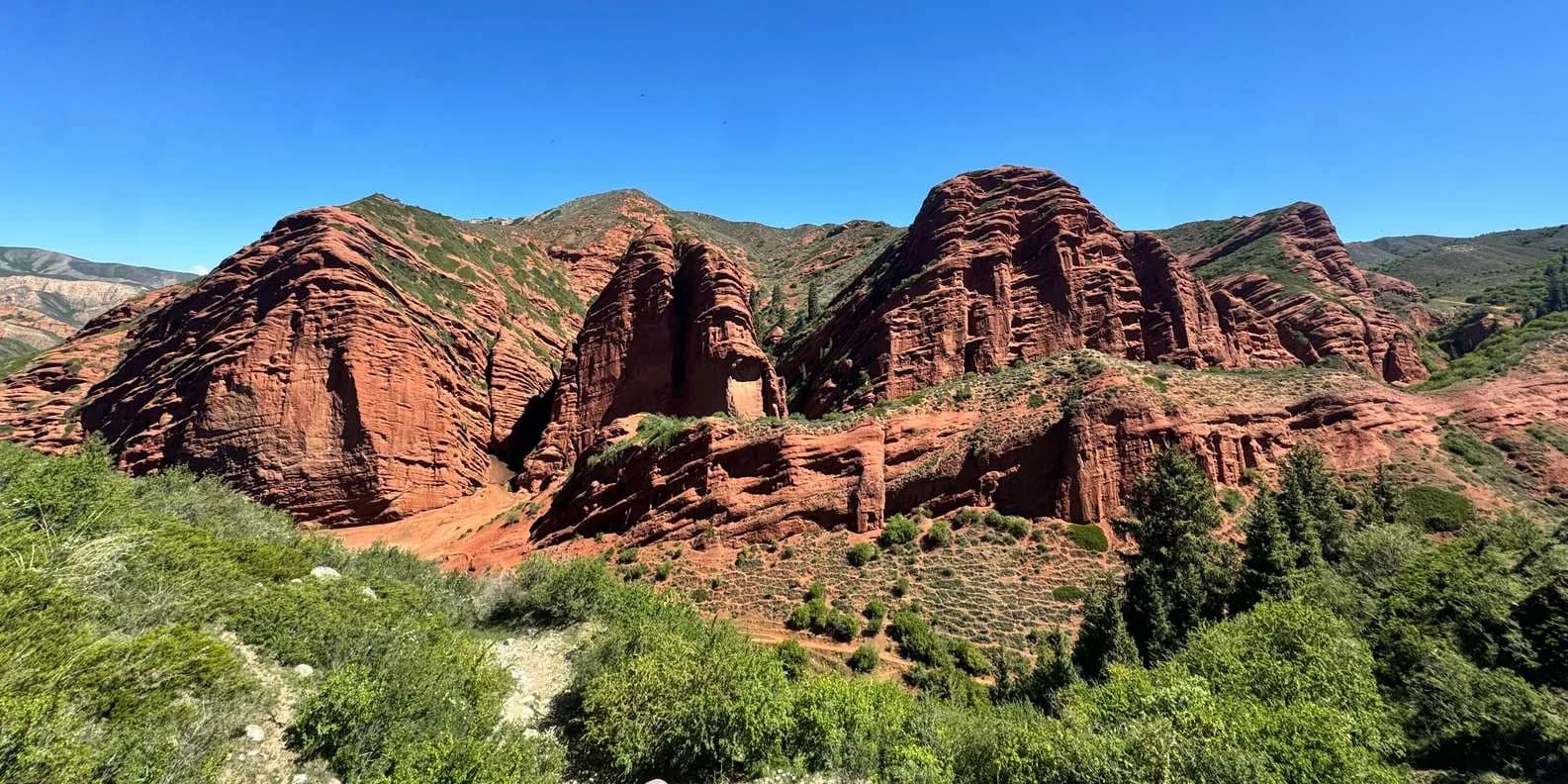
Boz-Uchuk Lakes Trek from Jyrgalan (2026)
A moderate 2–3 day trek to a string of alpine lakes above Jyrgalan — quieter than Karakol's classics, with community yurts, horses and clear DMO rates.
By TiK Editors8 min read
Self-Guided Treks in Kyrgyzstan: Routes & How-To
Yes, you can trek Kyrgyzstan without a guide. The best self-guided routes, the ones to skip, and the maps, water and safety logistics that make it work.
By TiK Editors12 min read