 Image via GetYourGuide
Kyrgyzstan Packing List: What to Bring (2026)
A practical, tested Kyrgyzstan packing list: warm layers, a proper sleeping bag, water filter, som cash, altitude meds and what to leave at home.
Book it on This is Kyrgyzstan
Turn this guide into a trip
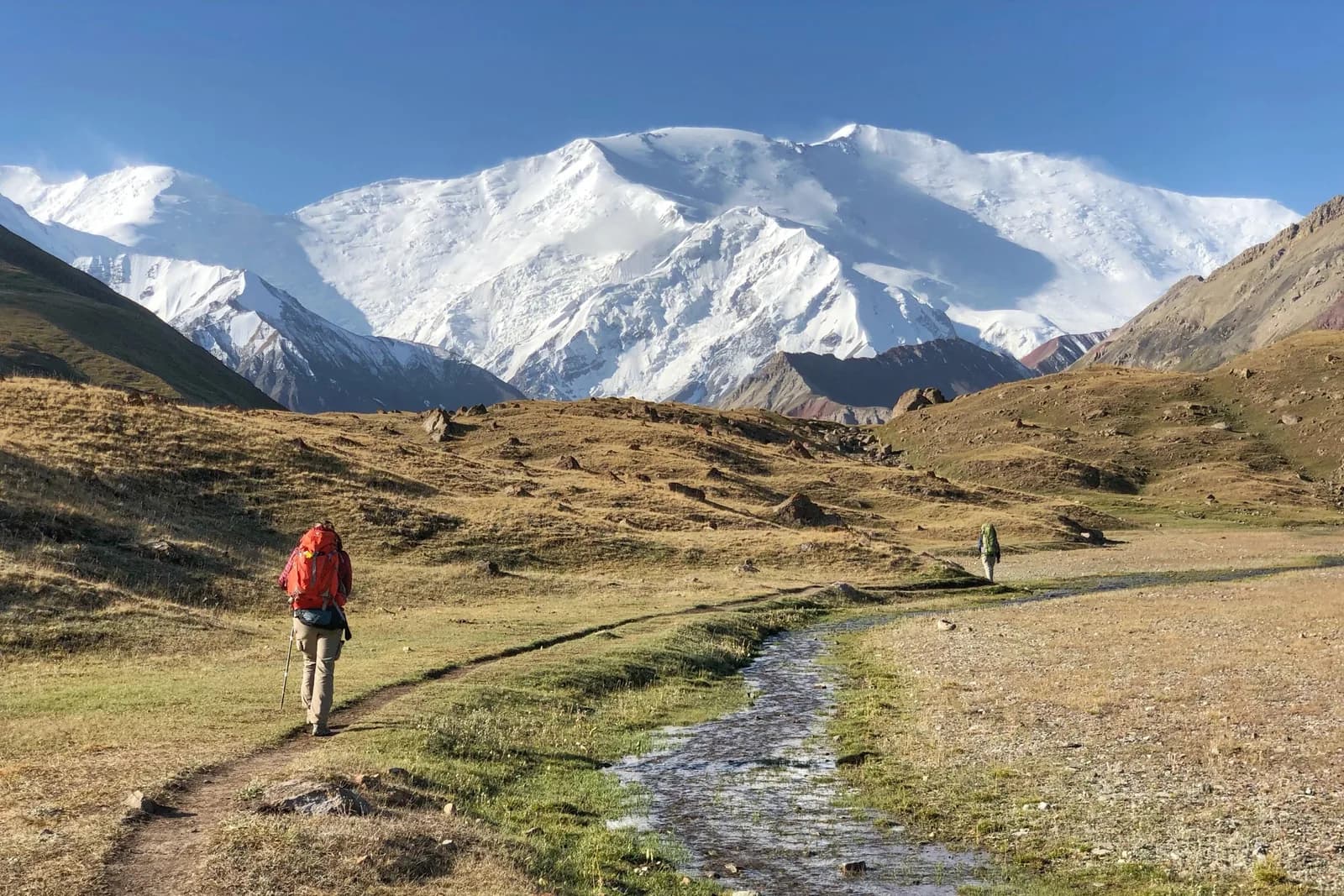
Pack for a country that puts you above 3,000 m within a day of an 800 m capital, keeps its cash economy alive outside the cities, and can throw frost at a summer yurt camp. That means real warm layers even in July, a sleeping bag the yurt won't provide, a way to treat water, a headtorch and power bank for nights with no electricity, and a thick wad of Kyrgyz som. Get those right and the rest is detail.
The organising principle is self-sufficiency. Once you leave Bishkek, Osh or Karakol, shops thin out, cards stop working, phone signal disappears in the high valleys, and "I'll buy it there" usually fails. Everything below is grouped so you can tick it off. Prices are in som and US dollars at roughly 87-88 KGS to the dollar (National Bank rate, late August 2026) - treat them as planning figures and confirm on the day.
Layers and clothing: the mountains swing hard
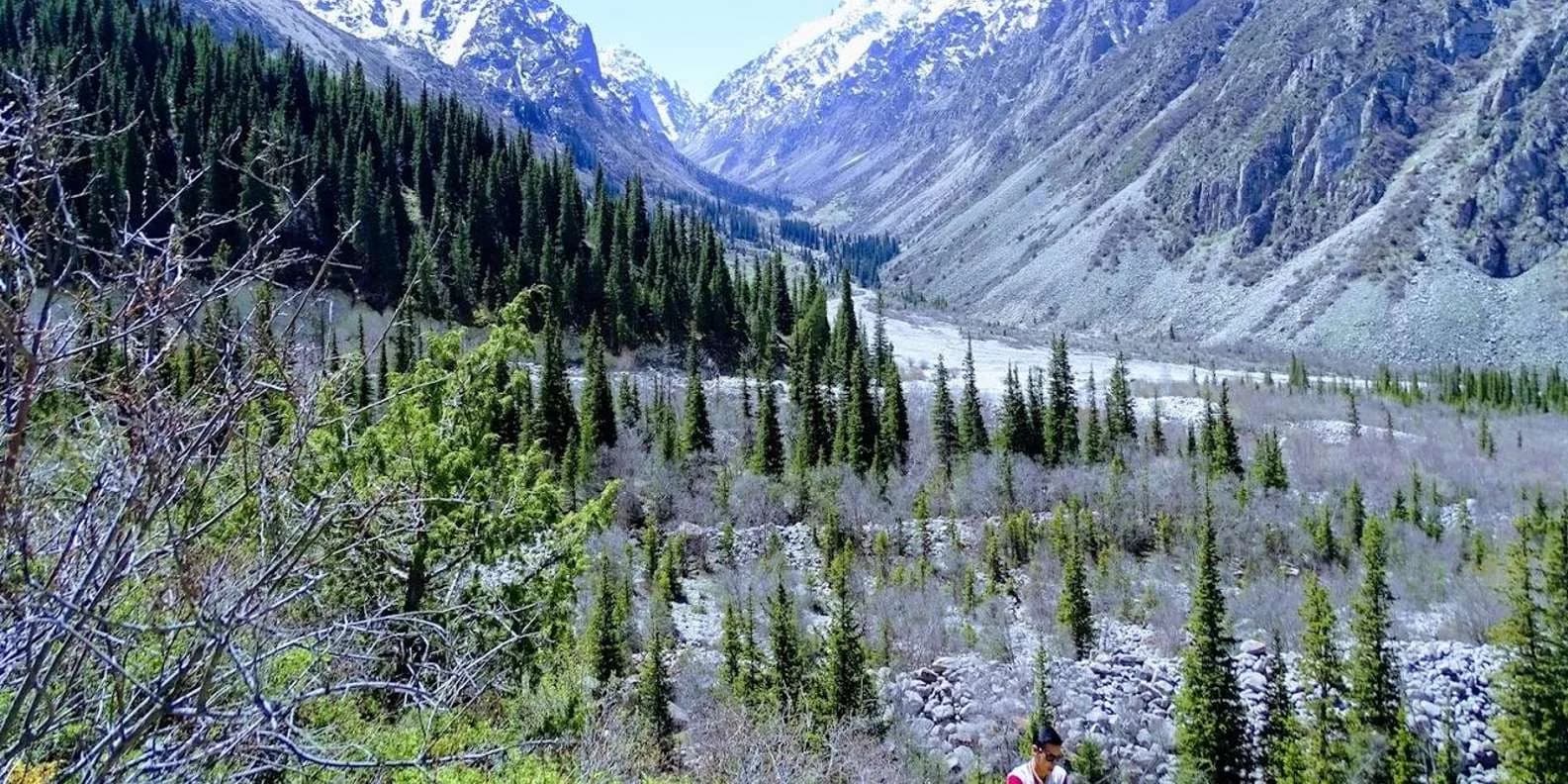
Altitude, not the calendar, drives the weather here. In July the Karakol and Bishkek valleys sit at 25-30°C, yet a camp at 3,500 m the same night can be -5°C to 0°C, and wind is a bigger problem than the raw temperature. Snow is possible at altitude in any summer month. So the answer is a layering system you can add to and strip off through the day, built around a genuinely windproof and waterproof shell.
Sturdy, broken-in, waterproof boots matter more than any other single item. Worn soles are the most common cause of falls on the loose scree that descends from passes like Ala-Kul, so retire tired treads before you fly. Trekking runners are fine for valley day walks and hopeless on a snow-flecked pass.
| Item | Notes |
|---|---|
| Waterproof/windproof shell jacket | Non-negotiable; weather turns in minutes |
| Insulated mid-layer (fleece or light down) | Warmth for camp and passes, packs small |
| Base layers (merino or synthetic) | 2-3; wicking, not cotton |
| Trekking trousers + warm leggings | Convertible or lightweight; leggings for cold nights |
| Sturdy waterproof boots, broken in | Ankle support for scree and jeep tracks |
| Trail shoes or sandals | Camp, river crossings, town |
| Warm hat, sun hat, buff, gloves | You will want all four in one day at altitude |
| Warm socks (wool) + spares | Cold nights, wet crossings |
| Modest layer for towns/sites | See etiquette below |
Leave heavy cotton jeans at home. They are dead weight wet, slow to dry, and useless as a warmth layer.
Trekking and yurt-stay kit
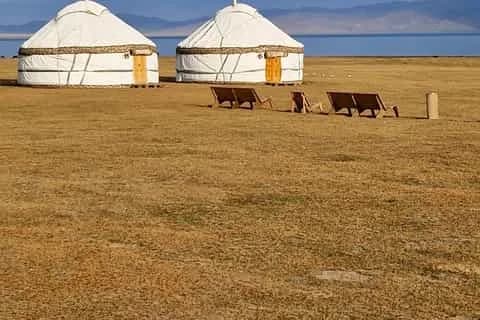
This is where people underpack and regret it. Yurt camps at Song-Köl, Tash Rabat and the jailoos do not supply sleeping bags, and there is no mains electricity - the stove is lit in the evening and typically goes out around midnight, after which the yurt cools to the outside air. At 3,016 m, Song-Köl can frost or even snow on any summer night.
Bring a sleeping bag with a comfort rating to at least -5°C for high camps; a three-season bag is the honest minimum, and a liner adds a few degrees for little weight. A head torch is essential once the stove dies, and a power bank is your only charger on a multi-day trek. Water is the other trap: streams are plentiful and cold, but every valley is grazed by sheep, horses and cattle all summer, so giardia is a real risk. Carry a filter or purification tablets and treat everything below the glacier snouts, however clear it looks.
| Item | Why it earns its place |
|---|---|
| Sleeping bag (comfort to -5°C or lower) | Camps don't supply one; nights sub-zero at altitude |
| Sleeping-bag liner | Extra warmth, keeps the hire/camp bag clean |
| Head torch + spare batteries | No electricity at jailoo yurts |
| Power bank (20,000 mAh+) | Only way to charge on multi-day treks |
| Water filter or purification tablets | Livestock foul every summer stream; giardia risk |
| Trekking poles | Vital on the loose scree off high passes |
| Dry bags / pack liner | Rain, river spray, jeep-track dust |
| Reusable insulated bottle + soft flask | Cold water carries, saves plastic |
| Small first-aid and blister kit | No pharmacy past the trailhead |
| Sit mat / inflatable pad | Yurt floors are thin; ground is cold |
A satellite messenger (Garmin inReach or Zoleo) is worth serious thought for anyone trekking. There is no phone signal in the Ala-Kul basin, at Song-Köl, in the Altyn-Arashan valley or on the Kel-Suu approach, and mountain rescue is a limited, volunteer-backed service that generally needs a payment guarantee before it launches. For the wider picture on routes and grades, see our guide to trekking in Kyrgyzstan and on sleeping under felt, yurt stays in Kyrgyzstan.
Gas canisters (screw-thread EN417) are sold in Bishkek and Karakol outdoor shops but stock is unreliable, so buy on arrival rather than counting on it en route. You cannot fly with them; plan accordingly.
Sun and altitude
UV at 3,000-4,000 m, amplified by snow reflection, is fierce - the FCDO explicitly warns of sunstroke and serious sunburn at altitude. High-factor sunscreen, a lip balm with SPF, a brimmed hat and category 3-4 sunglasses are not optional on the Ala-Kul pass or at Song-Köl, where snow blindness is a genuine risk.
Altitude illness is the thing visitors underestimate. Acute mountain sickness rarely develops below 2,500 m, but Kyrgyzstan's classic itineraries - Bishkek to Song-Köl in a day, or Karakol to the 3,860-3,900 m Ala-Kul pass within 48 hours of arriving - are exactly the fast-ascent profile that causes it. Acetazolamide (Diamox) is commonly carried for higher-risk ascents at 125 mg twice daily, started a day or two before you reach 3,500 m. Trial it at home first, ask your doctor, and treat it as a supplement to gradual ascent, not a replacement. The real prevention is an acclimatisation night at Kochkor or Naryn before going high, and never ascending while symptomatic. Confusion, loss of coordination or breathlessness at rest mean descend now.
Health kit
Medical facilities outside Bishkek are basic, and the correct response to anything serious is evacuation to the capital. Pharmacies exist in towns but may not stock what you need, and prescriptions can require Russian or Kyrgyz translation. Bring your own supply of anything you depend on, plus a compact kit.
| Health item | Note |
|---|---|
| Personal prescription meds (full trip + buffer) | Don't expect to refill rurally |
| Rehydration salts + loperamide | Traveller's diarrhoea is the routine complaint |
| Broad-spectrum antibiotic (from your GP) | For traveller's diarrhoea, prescribed at home |
| Acetazolamide (Diamox), if advised | Altitude prophylaxis; trial at home |
| Blister care, plasters, antiseptic, tape | Long descents wreck feet |
| High-SPF sunscreen + SPF lip balm | UV is severe at altitude |
| Insect repellent + tick tool | Ticks in forested areas, spring to autumn |
| Hand sanitiser | Cash economy, plenty of hand-to-mouth risk |
Rabies is present and free-roaming dogs are everywhere - village dogs, shepherds' guard dogs at the jailoos and street dogs in the cities. Pre-exposure vaccination is worth discussing with a travel clinic 4-6 weeks before you go, especially for trekkers, because rabies immunoglobulin can be hard to obtain in the region. Any bite, scratch or lick on broken skin means washing the wound for 15 minutes and seeking prompt treatment. None of this makes the country dangerous - the real risks are road traffic and mountain weather, not crime, as our guide on whether Kyrgyzstan is safe sets out.
Documents and money
Carry plenty of som cash. Kyrgyzstan looks cashless to locals - who pay by QR through domestic apps a visitor realistically cannot open - and is effectively cash-only to you. Cards work in Bishkek hotels, mid-range restaurants and supermarkets, and increasingly in Osh and Karakol, but they fail at bazaars, homestays, all CBT bookings, marshrutkas, horse hire, park gates and every yurt camp. Draw a big float before any mountain leg; a common suggestion is 50,000-70,000 som (roughly $570-800) for a multi-day rural excursion. Visa is the most reliably accepted scheme; Amex, Maestro and JCB are generally not accepted at all. Carry two cards from different banks, and choose "decline conversion" at ATMs.
| Document / money item | Detail |
|---|---|
| Passport, valid 6 months beyond arrival | Needed for entry and to buy a SIM |
| Visa-free check for your nationality | 30 days per rolling 60-day period for ~55 countries; others need an e-visa via evisa.e-gov.kg |
| Travel insurance to 4,000 m+ with heli-evac | Standard policies often cap at 2,500-3,000 m |
| Som cash float + two bank cards | Cards fail outside cities |
| USD/EUR cash, clean unmarked notes | Torn or pre-2009 US notes are refused |
| Printed permit(s) if going to Kel-Suu/Lenin Peak | Border-zone permit is paper, carried with passport |
| Copies of insurance, passport, bookings | Offline and paper backups |
Buy insurance that explicitly covers trekking to your maximum altitude - 3,900 m for Ala-Kul, higher for Lenin Peak - plus helicopter evacuation and repatriation. This is the single most-skipped essential. Border-zone permits are needed for Kel-Suu, Chatyr-Köl, Inylchek, Lenin Peak and the Torugart pass, but not for Song-Köl, Tash Rabat, Ala-Köl or Altyn-Arashan; where required, apply at least two weeks ahead.
Electronics and connectivity
Kyrgyzstan runs on 220V, 50Hz with European Type C and Type F sockets, so UK (Type G) and North American travellers need an adapter, and US-only devices need to handle 220V. Buy a local SIM at Manas (BSZ) or Osh airport for instant data - O!, Beeline and MegaCom sell tourist bundles for around 200-300 KGS ($2-4) for 20-30 GB, registered to your passport at the point of sale. An eSIM from Airalo, Saily or Nomad (from about $5/GB) is a convenient backup for short stays. Whichever you choose, download offline maps before you leave signal: 2GIS is best for towns and transport, and Maps.me or Organic Maps cover the trekking routes, with GPX tracks pre-loaded.
- Universal travel adapter (Type C/F) plus charging bricks
- Phone with offline maps and GPX tracks pre-loaded
- Power bank - there is no charging on the trail
- Camera and spare batteries; cold drains them fast
For how the buses, marshrutkas and shared taxis actually work, our guide to getting around Kyrgyzstan has the detail.
Season by season
What you pack shifts hard with the season - and in the shoulder months, half a mountain itinerary may simply be shut. High-altitude travel runs roughly mid-June to mid-September; May and October are transition months where passes and yurt camps open and close with the grass. For timing the trip itself, see the best time to visit Kyrgyzstan.
| Season | Conditions | Pack emphasis |
|---|---|---|
| Summer (mid-Jun to mid-Sep) | Hot valleys (35°C in Bishkek), sub-zero nights at altitude, afternoon storms | Full layering system, -5°C bag, sun protection, shell; camps all open |
| Shoulder (May, Oct) | Mud, washouts, snow risk on passes; many jailoo camps closed | Warm layers, waterproofs, flexible plans; verify openings locally |
| Winter (Dec-Mar) | Ski season; -14 to -16°C lows in Karakol and Naryn; Bishkek smog | Serious cold-weather kit, insulated boots, goggles; skip high treks |
Modesty and etiquette
There is no legal dress code. Bishkek is secular and cosmopolitan, and you can wear what you like there. Osh and rural southern Kyrgyzstan are markedly more conservative, so covering shoulders and knees in villages, in homestays and at religious sites is courtesy rather than compulsion. Pack one modest layer - a long skirt or trousers and a top that covers the shoulders - for mosques and sacred sites such as Sulaiman-Too. At a homestay or yurt, remove your shoes at the door, accept tea and kymyz when offered, and use your right hand for giving and receiving. A small gift for hosts lands better than a cash tip, which is not a local expectation.
What NOT to bring
- A single bank card. One-network outages are common; two cards from different banks, plus cash, is the rule.
- Reliance on cards or mobile wallets. The local payment apps are closed to short-stay visitors; you cannot pay your way through the mountains with a phone.
- Heavy cotton jeans. Slow to dry, cold when wet, no warmth. Bring quick-dry trousers instead.
- Camping gas canisters. You can't fly with them; buy on arrival in Bishkek or Karakol.
- A full camping kit you'll never use. On Ala-Kul you can trek hut-to-yurt without a tent; carry one only if you want the lake camp.
- A drone, casually. Border and permit-controlled zones are sensitive; don't fly near frontiers or checkpoints without checking the rules.
- New, unworn boots. Break them in at home, or you'll pay for it on the scree.
Ready to build the trip around the kit? Browse trekking tours across Kyrgyzstan and match the packing list to a real route.
Chat with a real person — free
Seif and the team reply on WhatsApp 24/7 — trip questions, custom plans and booking help.
Ask Seif on WhatsAppCommon questions
Do I need a sleeping bag for yurt stays in Kyrgyzstan?
Yes. Yurt camps at Song-Köl, Tash Rabat and the jailoos do not supply sleeping bags, and there is no mains electricity. The stove is lit in the evening but usually goes out around midnight, after which the yurt cools to the outside air. At 3,016 m, Song-Köl can frost or even snow on any summer night. Bring a bag with a comfort rating to at least -5°C, plus a liner for extra warmth.
What clothing do I need for Kyrgyzstan in summer?
A full layering system, even in July. Valleys hit 25-35°C by day, but a camp at 3,500 m the same night can be -5°C to 0°C, and snow is possible at altitude in any month. Pack wicking base layers, an insulated mid-layer, a waterproof and windproof shell, a warm hat and gloves, and sturdy broken-in waterproof boots. Wind is often a bigger problem than the raw temperature.
Should I bring cash or cards to Kyrgyzstan?
Bring plenty of som cash. Cards work in Bishkek hotels, better restaurants and supermarkets, and increasingly in Osh and Karakol, but they fail at bazaars, homestays, CBT bookings, marshrutkas, horse hire, park gates and every yurt camp. Draw a large float before any mountain leg - many travellers carry 50,000-70,000 som for a multi-day rural trip. Visa is most reliable; Amex and Maestro are not accepted. Carry two cards from different banks.
Do I need altitude sickness medication for Kyrgyzstan?
It's worth discussing with your doctor. Kyrgyzstan's classic routes take you from an 800 m capital to sleeping above 3,000 m within a day, exactly the fast ascent that triggers acute mountain sickness. Acetazolamide (Diamox) is commonly carried at 125 mg twice daily, started a day or two before reaching 3,500 m, but trial it at home first and treat it as a supplement to gradual ascent, not a replacement. Building in an acclimatisation night matters more than any pill.
What kind of travel insurance do I need for Kyrgyzstan?
A policy that explicitly covers trekking to your maximum altitude plus helicopter evacuation and repatriation. Standard policies frequently cap altitude cover at 2,500-3,000 m, which excludes almost every headline Kyrgyz trek - the Ala-Kul pass alone is 3,900 m. Mountain rescue is a limited, volunteer-backed service that generally requires a payment guarantee before it launches, so carry your policy number where a companion can find it.
What power adapter and SIM do I need in Kyrgyzstan?
Kyrgyzstan uses 220V, 50Hz with European Type C and Type F sockets, so UK and North American travellers need an adapter. Buy a local SIM at Manas (BSZ) or Osh airport - O!, Beeline and MegaCom sell tourist data bundles for around 200-300 KGS (roughly $2-4), registered to your passport. An eSIM from Airalo or Saily works as a backup. Download offline maps (2GIS, Maps.me) before you leave signal, which vanishes in the high valleys.
Do I need to dress modestly in Kyrgyzstan?
There is no legal dress code, and Bishkek is secular and cosmopolitan. Osh and rural southern Kyrgyzstan are more conservative, so covering shoulders and knees in villages, homestays and at religious sites like Sulaiman-Too is courtesy rather than compulsion. Pack one modest layer for mosques and sacred sites. At a homestay or yurt, remove shoes at the door and use your right hand for giving and receiving.
Do I need a water filter for trekking in Kyrgyzstan?
Yes, for any multi-day trek. Streams are plentiful and cold, but every valley is grazed by sheep, horses and cattle all summer, so giardia is a real risk even in crystal-clear water below a jailoo. Carry a filter or purification tablets and treat everything below the glacier snouts. Tap water in towns is also not reliably potable - boil, filter or stick to bottled water, which is easy to buy in towns and at roadside stops.
What should I not bring to Kyrgyzstan?
Skip heavy cotton jeans (cold and slow to dry), a single bank card (network outages are common), and any reliance on mobile-wallet apps, which are closed to short-stay visitors. Don't pack camping gas canisters - you can't fly with them, so buy on arrival in Bishkek or Karakol. Leave new, unworn boots at home; break them in first, because worn or unfamiliar soles cause most falls on the loose scree off high passes.
Book it on This is Kyrgyzstan
Turn this guide into a trip
Kyrgyzstan's bestsellers
The experiences travelers book most, across the country
Keep reading
Self-Guided Treks in Kyrgyzstan: Routes & How-To
Yes, you can trek Kyrgyzstan without a guide. The best self-guided routes, the ones to skip, and the maps, water and safety logistics that make it work.
By TiK Editors12 min read
Uchitel Peak: Your First 4,000m Climb (2026)
Pik Uchitel (~4,400-4,600 m) in Ala-Archa is the classic first summit for fit hikers new to mountaineering: route, gear, season and acclimatisation.
By TiK Editors8 min read
Tian Shan Traverse: Bikepacking Kyrgyzstan
The Tian Shan Traverse is a self-supported, mostly off-road bikepacking route of about 1,000 km across the high Kyrgyz mountains. Here's how to plan it.
By TiK Editors9 min read