 Image via GetYourGuide
Is Kyrgyzstan Safe? An Honest Guide (2026)
Yes — and as of August 2026 there is no FCDO advise-against zone anywhere in Kyrgyzstan. The real risks are roads, altitude and weather, not crime. Here is the detail.
Book it on This is Kyrgyzstan
Turn this guide into a trip
Yes — and here are the two facts that should change your plan. As of 29 August 2026, the date we last checked both advisories, the UK Foreign, Commonwealth & Development Office has no "advise against travel" zone anywhere in Kyrgyzstan (regional-risks page updated 19 June 2026). That is a real change: for years a strip of the Tajik border in Batken was designated no-go, and much of what you will read online still describes a country that no longer exists. The US State Department has Kyrgyzstan at Level 1 – Exercise Normal Precautions (issued 10 February 2026, updated 11 June 2026), with a Level 2 band only within 30 km of the Tajikistan border, in Batken and Leilek districts.
What unlocked that was the Khujand border treaty with Tajikistan, signed 13 March 2025, which delimited the frontier by land exchange, committed both sides to demilitarisation and reopened crossings. The FCDO records no clashes since. It does still flag residual unexploded ordnance and mines "particularly in the border areas of the Batken region" — the June update was made specifically to add that.
Now the thing most safety pages get backwards. Violent crime against tourists here is rare. What is most likely to hurt you is a car.
Advisories move: check your own government's before booking — gov.uk/foreign-travel-advice/kyrgyzstan, travel.state.gov, or your foreign ministry's equivalent.
Kyrgyzstan safety at a glance
| Risk | How likely | What to actually do |
|---|---|---|
| Road crash, or being hit as a pedestrian | By far the highest real risk | Travel by day, belt on, refuse a drunk or exhausted driver, bus over shared taxi |
| Altitude sickness | Common on Song-Köl and Ala-Kul itineraries | Acclimatisation night first, +500 m sleeping altitude max per day, descend on symptoms |
| Stomach upsets, giardia | Common | Treat all water; filter streams on treks |
| Petty theft and overcharging | Occasional | Yandex Go, not street cars; watch bags at Osh Bazaar |
| Drowning at Issyk-Köl | Every summer | Don't swim out or after drinking; no lifeguards |
| Dog bite, rabies exposure | Uncommon, but serious | Dog protocol, wash 15 min, urgent post-exposure treatment |
| Mugging or drink spiking | Rare, alcohol-linked, Bishkek nightlife | App taxi at night; buy and watch your own drinks |
| Political unrest | Rare, episodic, Bishkek-centred | Avoid demos and Ala-Too Square; keep a flight buffer |
| UXO near the Tajik border | Rare, geographically confined | Roads and marked paths only in Batken |
The real danger is the roads
The WHO's 2023 road safety report puts Kyrgyzstan at an estimated 869 road deaths in 2021, a rate of 13.3 per 100,000 — roughly four to six times the Western European level. The striking figure is the breakdown: 40% of those killed were pedestrians. Crossing the street here is a hazard in its own right.
The reasons are visible from the passenger seat. Overtaking on blind bends is routine, lane discipline is notional, livestock stand on the carriageway all summer, and rural roads are unlit — as are the people and animals walking along them at dusk. Cars are old. Shared-taxi and marshrutka drivers are paid per trip, which rewards speed and long days. Mountain roads add rockfall, snow and avalanche closures; the Bishkek–Osh highway shuts at Töö-Ashuu when avalanche risk climbs.
What measurably lowers your risk:
- Travel by day. Night driving concentrates nearly every hazard above.
- Wear the seatbelt, in the back too, even if the driver laughs.
- Refuse a drunk or exhausted driver, and be willing to get out mid-journey. It is the highest-value decision on this page.
- Prefer a scheduled bus to a shared taxi — on the Karakol run, the GoBus night coach beats a night shared taxi.
- Fly Bishkek–Osh if the drive is transport rather than sightseeing: an hour, against 10–12 hours' driving and 11–13 in a shared taxi with stops.
- In cities, cross at lights and assume nobody is stopping. Watch open aryks and broken pavement after dark; they injure more visitors than criminals do.
More on modes and fares in our guide to getting around Kyrgyzstan.
Crime: what actually happens
The realistic list is short. Taxi overcharging is what you are most likely to meet — endemic at Manas airport and with any street-flagged car, and solved by using Yandex Go. Then pickpocketing in crowds, with Osh Bazaar in Bishkek named by the FCDO, bag snatching, and muggings in downtown Bishkek after dark, usually alcohol-involved. The FCDO also flags drink spiking in bars and clubs, with sexual assault risk.
OSAC rates Bishkek a low-threat location for crime. Police corruption exists: if stopped, ask for identification, don't hand over your passport or valuables voluntarily, and report anything serious to your embassy. Walking central Bishkek in the evening is unremarkable; walking home drunk and alone at 3am down unlit side streets is where incidents happen.
Mountains: altitude, weather and rescue
Kyrgyzstan puts ordinary tourists above 3,000 m faster than almost any other budget destination. Song-Köl is 3,016 m; the Ala-Kul pass is given variously as 3,860–3,900 m (sources differ), with Ala-Köl lake around 3,530–3,560 m. Bishkek is 800 m. The standard Bishkek–Kochkor–Song-Köl run takes you from 800 m to sleeping at 3,016 m in a day — exactly the profile that produces acute mountain sickness.
AMS is a headache plus at least one of nausea, dizziness, fatigue or disturbed sleep, usually 6–10 hours after going above 2,500 m, and self-limiting if you stop ascending. The dangerous progressions are HACE (confusion, loss of coordination — classically, being unable to walk a straight line) and HAPE (breathlessness at rest, cough). Never ascend with symptoms; descend if they worsen. Descent is the treatment. Fitness offers no protection.
In practice: sleep a night in Kochkor (~1,800 m) or Naryn (~2,000 m) before Song-Köl or Kel-Suu; take two nights in Karakol before the Ala-Kul trek; never schedule the pass for the day after arriving from Bishkek. Above 3,000 m, gain no more than 500 m of sleeping altitude a day.
The FCDO warns of a high risk of avalanches, landslides and rockfall, and snow at altitude even in summer. The high-pass season is roughly mid-June to mid-September; the Ala-Kul pass commonly holds snow into July and can be snowed on in August. Unpaved passes like Kegeti (3,785 m) and Tosor (3,893 m) shut all winter. Sun at 3,000–4,000 m with snow reflection is fierce — high-factor sunscreen, a brimmed hat and category 3–4 sunglasses are equipment, not comfort.
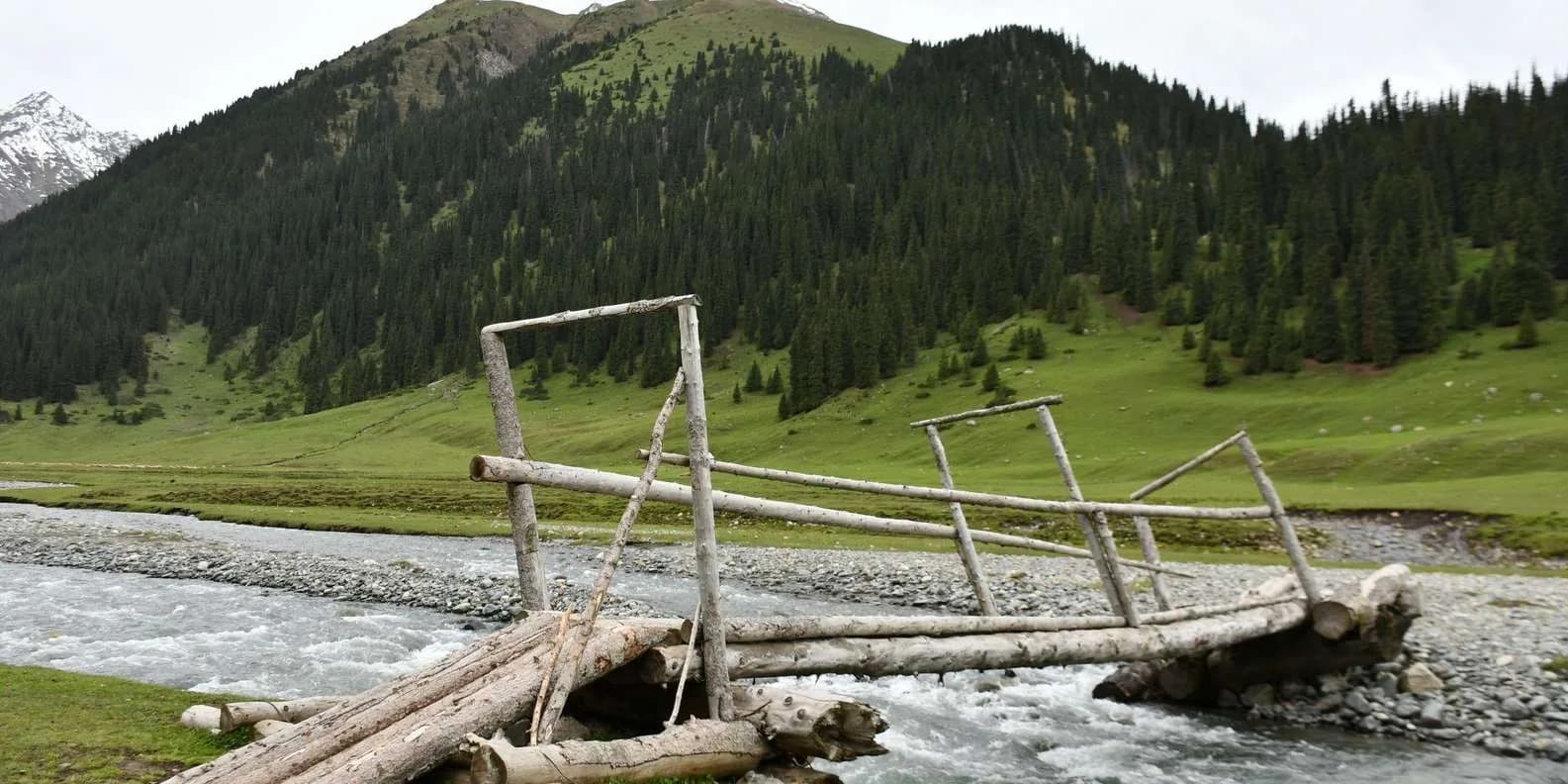
River crossings are the most underestimated hazard. Glacier-fed streams are melt-driven: ankle-deep at 8am, thigh-deep and pushy by 4pm. Cross early, unclip your hip belt, face upstream, keep shoes on, be willing to turn back. Log bridges wash out — a bridge on a map is not a promise.
Rescue is limited. The FCDO describes "a basic mountain rescue service staffed by volunteers" with limited equipment; the 24-hour number is +996 312 651 404. There is no state helicopter service on the Alpine model; lifts are arranged commercially, cost a great deal and depend on weather. Most valleys have no phone signal, so a satellite messenger or PLB is the realistic way to raise an alarm.
Which makes insurance non-negotiable: buy a policy that explicitly covers trekking to your maximum altitude — 3,900 m for Ala-Kul, far higher for Lenin Peak — plus helicopter evacuation and repatriation. Standard policies routinely cap altitude cover at 2,500–3,000 m, quietly excluding almost every headline Kyrgyz trek. See our trekking guide for route altitudes.
Health
Book a travel clinic 4–6 weeks out. TravelHealthPro recommends routine vaccinations for everyone, hepatitis A and a tetanus booster for most, and hepatitis B, rabies, tick-borne encephalitis, typhoid and BCG for some. Measles is endemic.
Rabies deserves real attention. Free-roaming dogs are everywhere, including working livestock-guarding dogs at jailoo camps. Don't run or turn your back: stop, keep a trekking pole between you and the dog, wait for the shepherd. After any bite, scratch or lick on broken skin, wash 15 minutes with soap and running water and get post-exposure treatment urgently — immunoglobulin is hard to source regionally, which is the argument for pre-exposure vaccination if you're trekking.
Ticks are present spring to autumn, with TBE risk documented in Chui region border areas. Tap water is not reliably potable — boil, filter or treat. Giardia matters most to trekkers: clear water below a grazing jailoo is contaminated. Unpasteurised dairy is central to the food, and kymyz at a yurt camp is a genuine cultural experience with a genuine, small brucellosis risk. Eat meat well cooked; the FCDO notes anthrax cases among southern livestock.
Bishkek's private clinics are the only facilities approaching Western standards; Osh is a distant second; elsewhere, the answer to anything serious is evacuation to Bishkek and probably onward. Payment is usually cash up front. The emergency number is 112 (102 police, 103 ambulance) — don't assume an English-speaking operator, so have a guesthouse owner or driver call.
Solo travellers and women travellers
Kyrgyzstan is a well-established solo destination, especially for trekkers, and the homestay network makes it structurally easy: you are usually in somebody's house, not alone in a hotel. Reported experience from women travelling alone is broadly positive, and hitchhiking is widely practised, though it normally means paying roughly marshrutka rates. Treat any "safety score" you see with suspicion — there is no authoritative survey data for Kyrgyzstan.
What is commonly reported is staring and persistent attention in bazaars and from taxi drivers, not serious incidents. There's no legal dress code; Bishkek is secular and cosmopolitan, while Osh and the rural south are markedly more conservative, and covering shoulders and knees there is courtesy. Practical measures beat clothing: app taxis after dark, drinks never left unattended, fares agreed before you get in, guesthouses over isolated accommodation.
Ala kachuu. Non-consensual bride kidnapping — "grab and run" — is a real and serious social problem, principally rural and principally affecting young Kyrgyz women. It has been illegal since 1997, recodified in December 2021 with a three-to-five-year sentence, though enforcement is inconsistent and widely quoted prevalence figures are contested by researchers. It does not target foreign visitors: neither the FCDO nor the State Department lists it as a traveller risk, because it is embedded in local marriage and kinship structures rather than being opportunistic abduction of strangers. Kyrgyz lawyers, journalists and activists campaign against it. Read about it; don't travel afraid of it.
LGBTQ+ travellers
Same-sex sexual activity has been legal since 1998, but same-sex relationships have no legal recognition — the constitution has barred it since 2016 — and an August 2023 amendment to the child protection law prohibits content promoting "non-traditional sexual relations". Society is conservative, discrimination and violence are reported, and there is no visible scene. Most LGBTQ+ visitors travel without incident and are discreet in public. Check your own government's LGBT+ travel guidance; the FCDO links to its dedicated page from the Kyrgyzstan advisory.
Politics and protest
Kyrgyzstan has removed three presidents by street protest this century: the 2005 Tulip Revolution, the April 2010 revolution, and the October 2020 unrest after a disputed parliamentary election. All three centred on Ala-Too Square and the White House in Bishkek, lasted days, and briefly disrupted flights and roads. Since the parliamentary election of 30 November 2025 things have been quiet, with large opposition rallies uncommon under tightened restrictions — though the FCDO still calls demonstrations regular and warns they can turn violent with little warning. If something starts: avoid demonstrations and Ala-Too Square, don't photograph police lines, follow embassy messaging and local news, and keep a change buffer in your flights around an election.
Region by region
Bishkek — normal city precautions; the real risks are traffic, downtown muggings after dark, pickpockets at Osh Bazaar, and severe winter air pollution from about November to February.
Osh — calm and routinely visited. The June 2010 ethnic violence between Kyrgyz and Uzbek communities killed 426 people by the national commission's count and displaced tens of thousands; the grievances have not evaporated, but there has been no recurrence and visitors were never a target. The city changed in 2025: the Lenin statue was moved and the central bazaars relocated.
Issyk-Köl (Issyk-Kul) — the risk is water, not people. Cold water, strong offshore winds and no lifeguards on most beaches; drownings occur every summer.
Trekking regions — Karakol, Jyrgalan, Song-Köl, Naryn, the Alay. Crime is a non-issue; weather, altitude, rivers and dogs are the risks.
Batken and the Tajik border — open, no FCDO advise-against zone, US Level 2 within 30 km. Stay on roads and marked paths, don't wander fields near the frontier, and don't drive minor roads around Sokh, Vorukh and Isfara without local advice — enclave boundaries are not obvious on the ground.
Earthquakes are a countrywide background hazard; a magnitude 5.4 event struck northern Kyrgyzstan in October 2025. Know drop-cover-hold and note your exit in older buildings.
Sensible precautions, Kyrgyzstan-specific
- Insurance naming your maximum altitude, helicopter evacuation and repatriation.
- Yandex Go in Bishkek and Osh; a price agreed before you get into any other car.
- Day travel over night travel, always. Seatbelt, always.
- A water filter for multi-day treks; a satellite messenger beyond day hikes.
- Enough cash in som to pay a clinic up front.
- Your route left with somebody, and embassy travel registration done.
- The dog protocol learned before your first jailoo, and the pass forecast checked rather than the valley one.
- Your nationality's visa rules confirmed — they changed on 31 December 2025 to 30 days in a rolling 60-day window for most visa-free nationals. See our visa and entry guide.
None of that is exotic. Kyrgyzstan rewards ordinary competence and is far kinder to visitors than its reputation among people who have never been. Start with our Kyrgyzstan travel guide — and if you would rather have a vetted driver and a guide who knows which pass is open this week, tell us what you want and we will build it.
Chat with a real person — free
Seif and the team reply on WhatsApp 24/7 — trip questions, custom plans and booking help.
Ask Seif on WhatsAppCommon questions
Is Kyrgyzstan safe to visit in 2026?
Yes. As of 29 August 2026 the UK FCDO has no advise-against-travel zone anywhere in Kyrgyzstan, and the US State Department rates it Level 1, exercise normal precautions, with a Level 2 band only within 30 km of the Tajik border. Violent crime against tourists is rare. The realistic risks are road traffic, altitude and mountain weather, in that order.
Is Bishkek safe for tourists?
Yes, with normal city sense. OSAC rates Bishkek a low-threat location for crime. The reported problems are pickpocketing at Osh Bazaar, bag snatching, taxi overcharging and alcohol-related muggings downtown after dark. Use Yandex Go at night rather than flagging cars, keep drinks in sight in bars, and watch broken pavement and open drainage channels.
Is Kyrgyzstan safe for solo female travellers?
It is one of Central Asia's more straightforward countries for solo women, especially trekkers, partly because homestays put you in a family house. Staring and persistent attention in bazaars and taxis are commonly reported; serious incidents against visitors are not. Use app taxis after dark, never leave a drink unattended, and dress more conservatively in Osh and the rural south.
Is bride kidnapping a risk for tourists?
No. Ala kachuu is a real and serious domestic problem, illegal since 1997 and recodified in 2021 with a three-to-five-year sentence, but it is embedded in local marriage and kinship structures and affects young Kyrgyz women, mainly in rural areas. Neither the FCDO nor the US State Department lists it as a risk to travellers.
Are Batken and the Tajikistan border safe now?
They are open. The Khujand treaty of 13 March 2025 ended the border clashes and the FCDO records none since, so there is no UK advise-against zone. The US keeps a Level 2 band within 30 km of the border in Batken and Leilek. Residual unexploded ordnance means staying on roads and marked paths near the frontier.
Is Osh safe after the 2010 violence?
Yes. The June 2010 ethnic violence killed 426 people by the national commission's count and displaced tens of thousands, but there has been no recurrence and Osh is calm and routinely visited. No advisory restricts travel there. Note the city changed in 2025: the Lenin statue was moved and the central bazaars relocated.
Do I need special insurance for trekking in Kyrgyzstan?
Yes. Standard policies often cap altitude cover at 2,500 to 3,000 m, which excludes almost every well-known Kyrgyz trek. Buy a policy that explicitly covers your maximum altitude, 3,900 m for the Ala-Kul pass and far higher for Lenin Peak, plus helicopter evacuation and repatriation. Mountain rescue here is a limited volunteer service.
Will I get altitude sickness in Kyrgyzstan?
Possibly. Song-Köl is 3,016 m and the Ala-Kul pass around 3,860 to 3,900 m, both reachable within a day or two of 800 m Bishkek. Mild AMS, headache and poor sleep, is common on that profile. Sleep a night at Kochkor or Naryn first, gain no more than 500 m of sleeping altitude a day, and descend if symptoms worsen.
Can I drink the tap water in Kyrgyzstan?
No. Tap water is not reliably potable anywhere; boil, filter or treat it, or buy bottled. Trekkers should filter mountain streams too, because water below a grazing jailoo carries livestock contamination and giardia is the routine complaint.
Book it on This is Kyrgyzstan
Turn this guide into a trip
Kyrgyzstan's bestsellers
The experiences travelers book most, across the country
Keep reading
Kyrgyzstan Visa Requirements 2026: 30 Days, Not 60
Kyrgyzstan cut its visa-free stay to 30 days in a rolling 60-day window on 31 December 2025. E-visa, registration, overstay and border rules, verified for 2026.
By TiK Editors12 min read
Kyrgyzstan Travel Cost: Real 2026 Budgets in Som & USD
What Kyrgyzstan actually costs in 2026: three daily budgets in som and dollars, real marshrutka and yurt prices, and why transport — not beds — decides your total.
By TiK Editors11 min read
Kyrgyz Food Guide: What to Eat in Kyrgyzstan (2026)
Kyrgyzstan eats three cuisines at once — nomad, Ferghana and Dungan. What beshbarmak, lagman and ashlyamfu really are, what they cost, and how to order.
By TiK Editors13 min read